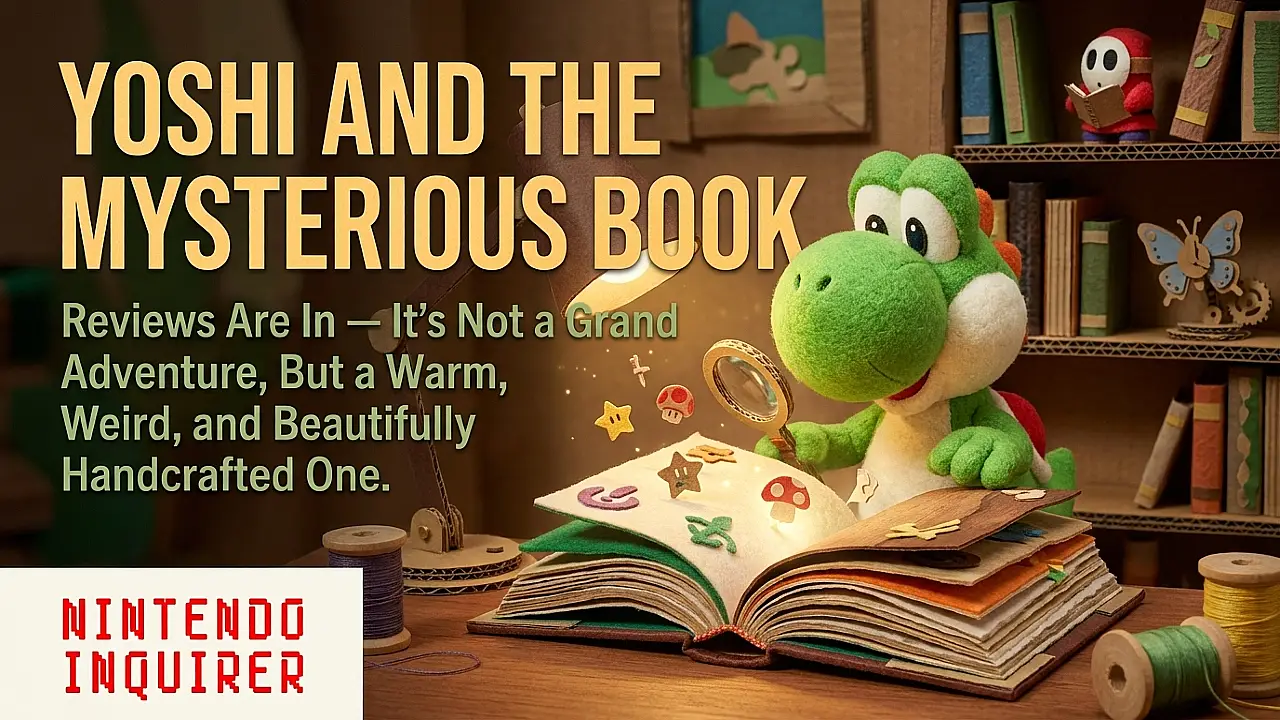
Yoshi and the Mysterious Book launches on Nintendo Switch 2 on May 21, 2026, and the reviews went live earlier this week. The consensus is clear: this is not a radical reinvention of the platforming genre, nor is it the sprawling, open-ended adventure that some might have hoped for after the Mario Galaxy Movie reminded everyone how magical Nintendo can be.
Instead, it’s something quieter. A game built from construction paper and glue, populated by strange creatures with even stranger names. Critics are calling it the Switch 2’s first truly beautiful game — and one of the most heartfelt entries in the Yoshi series to date.
Here’s what the reviews say, what the game actually is, and why the gaps in its design might be the point.
The Reviews: Handcrafted Charm Over Blockbuster Scale
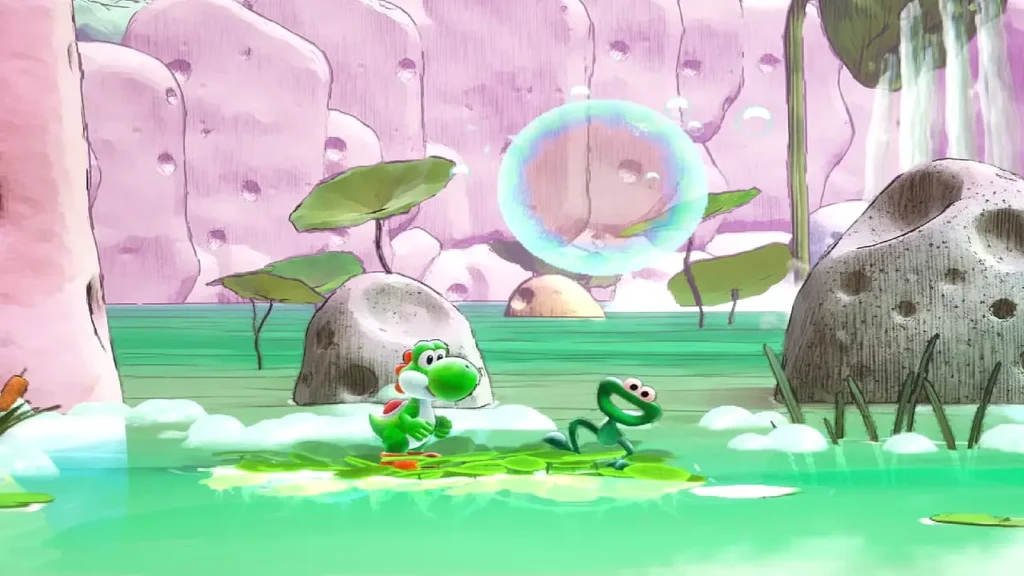
Across the board, critics are praising the game’s aesthetic direction — a diorama-inspired, arts-and-crafts style that evokes Yoshi’s Woolly World and Kirby’s Epic Yarn, but pushes the concept further into something stranger and more personal.
Nintendo Life, in their 8/10 review, called the game “a warm hug for the eyeballs,” but noted that it doesn’t quite reach the heights of Nintendo’s biggest platformers:
“The Yoshi series has cemented itself as one of the most approachable in Nintendo’s arsenal, providing experiences that younger gamers in particular can enjoy without too much friction… Yoshi and the Mysterious Book is a beautifully crafted game, but one that feels content to be merely lovely rather than truly great.”
VGC struck a similar tone in their 4/5 review:
“It feels like it could be a real gem. Like Nintendo took the systemic creativity of Breath of the Wild and shrunk it down to fit inside a pop-up book.”
IGN called it “the most E-rated of Nintendo’s recent slate” — a game designed for families, for younger players, and for anyone who finds comfort in a world made of felt and cardboard.
And Vandal, the Spanish outlet, was perhaps the most effusive:
“Nintendo demuestra un gran talento artístico y jugable” (“Nintendo demonstrates great artistic and playful talent”).
The average review score sits around 82 on Metacritic, placing it firmly in the “very good” category — not a generation-defining masterpiece, but a game that delivers exactly what it promises: charm, creativity, and a world you want to live inside.
What the Game Actually Is
Yoshi and the Mysterious Book is not a traditional linear platformer. Instead, it’s built around a series of creature habitats — miniature sandboxes inside the pages of a magical, sentient book named Mr. E.
The structure works like this: Yoshi leaps into a habitat, explores it freely, and discovers a creature. He learns what it can do — whether it bounces, flies, or hates mud — and that knowledge is physically scribbled onto the level’s scenery. Then, once the creature is fully understood, you earn the right to name it.
The naming mechanic has already become a meme among early players. Preview coverage showed creatures being named everything from “Geezers” to increasingly absurd joke names, and the free-text input means the only limit is your imagination — and Nintendo’s content filters.
Nintendo Life described the tonal shift from previous games: “The game introduces young kids to Mario-like characters in a much more chilled out environment than something like Mario Wonder.”
It’s a game about discovery, not difficulty. About patience, not precision. And that’s either its greatest strength or its most glaring weakness, depending on what you want from a platformer.
A Satisfying Mystery: Who Made This Game?
For weeks, Nintendo refused to name the developer behind Yoshi and the Mysterious Book. The credits simply listed Nintendo as the publisher, and speculation swirled. Was it Good-Feel, the studio behind Yoshi’s Woolly World and Yoshi’s Crafted World? A new internal Nintendo team? Someone else entirely?
The answer, uncovered by Nintendo Life just ahead of launch, is genuinely satisfying. The game was developed by Good-Feel — the same studio behind the two most recent and critically acclaimed Yoshi games.
“Yoshi and the Mysterious Book hits store shelves in just a couple of days, but in true Nintendo fashion, the company has not explicitly revealed who actually developed the ruddy thing. So we’ll do it instead – how’s that? It shouldn’t come as a huge surprise to learn that Mysterious Book was developed by none other than…”
This matters because it means the game is in experienced hands. Good-Feel has spent the better part of a decade perfecting the “crafted” aesthetic that defines modern Yoshi, and Mysterious Book represents the culmination of that expertise.
The Context: Launching Into a Price Hike
The game arrives at a complicated moment for the Nintendo Switch 2.
On May 25 — just four days after Yoshi’s launch — the Japanese price of the Switch 2 will rise by ¥10,000 (20%), from ¥49,980 to ¥59,980. The U.S. and European price hikes follow on September 1, pushing the console to $499.99 and €499.99 respectively.
Nintendo has acknowledged that the increase “will raise the barrier to purchase to some extent,” and the company’s stock has fallen more than 30% since the start of the year amid investor concerns about the console’s trajectory.
In that environment, every first-party release carries additional weight. Yoshi and the Mysterious Book is not the system-seller that a new 3D Mario or Zelda would be — Nintendo’s president Shuntaro Furukawa has confirmed that those “new titles beyond those already announced” are coming in the second half of the fiscal year — but it’s a reminder that the Switch 2’s library is steadily, quietly growing.
The Switch 2’s Summer Slate: Where Yoshi Fits
Yoshi and the Mysterious Book kicks off a surprisingly packed summer for the console.
| Game | Release Date |
|---|---|
| Yoshi and the Mysterious Book | May 21, 2026 |
| Star Fox (remake) | June 25, 2026 |
| Rhythm Heaven Groove | July 2, 2026 |
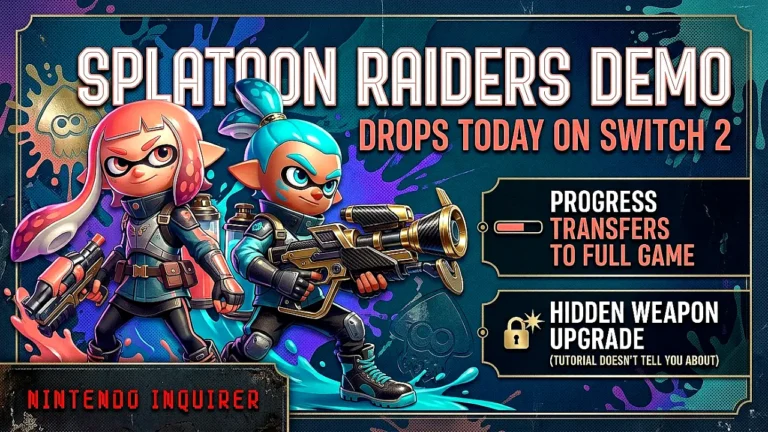
| Splatoon Raiders | July 23, 2026 |
| Fire Emblem: Fortune’s Weave | TBA 2026 |
That’s four first-party releases in ten weeks — an unusually dense cadence for Nintendo, and one that suggests the company is working to build momentum ahead of the September price hike.
FAQ: What You Need to Know
Q: When is Yoshi and the Mysterious Book coming out?
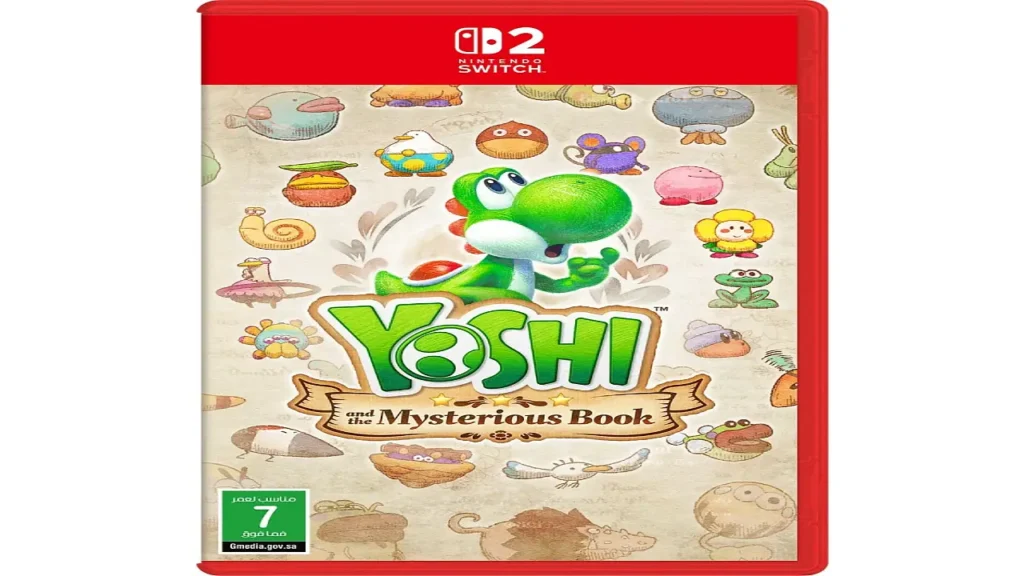
A: May 21, 2026, exclusively on Nintendo Switch 2.
Q: Who developed the game?
A: Good-Feel, the studio behind Yoshi’s Woolly World and Yoshi’s Crafted World.
Q: Is it a traditional Yoshi platformer?
A: Not exactly. It’s structured around creature habitats and discovery, not linear level progression. Think of it as a series of miniature sandboxes.
Q: Is it too easy?
A: Yes, deliberately so. Multiple reviews note that the game is designed for younger players and families, and that challenge-seekers may find it too gentle.
Q: What’s the Metacritic score?
A: Around 82 as of this writing, with most reviews landing in the 8/10 or 4/5 range.
Q: Do I need to have played other Yoshi games?
A: No. The story is standalone, and the mechanics are introduced gradually.
Q: How long is the game?
A: No official playtime has been confirmed, but preview coverage suggests a longer, more open experience than previous Yoshi titles.
The Bottom Line
Yoshi and the Mysterious Book is the kind of game that doesn’t make headlines at The Game Awards. It’s not a technical showcase. It’s not a bold reinvention. It’s a warm, strange, lovingly crafted thing — a pop-up book brought to life by a studio that has spent years perfecting the art of making games feel like they were stitched together by hand.
Reviews suggest it won’t change anyone’s mind about the Yoshi series. If you’ve never clicked with these games before, this one probably won’t convert you. But if you’ve ever found comfort in a world made of yarn, or felt, or construction paper — if you’ve ever wanted to name a creature something ridiculous and watch it waddle around a diorama — then Mysterious Book was made for you.
The Switch 2’s library is still taking shape. This is a quiet, confident, and deeply charming piece of it.
Are you picking up Yoshi and the Mysterious Book on day one? What’s the first creature you’re going to name? Let us know in the comments.
About the Author